What is margin?
When trading forex, you are only required to put up a small amount of capital to open and maintain a new position.
This capital is known as the margin.
For example, if you want to buy $100,000 worth of USD/JPY, you don’t need to put up the full amount, you only need to put up a portion, like $3,000. The actual amount depends on your forex broker or CFD provider.
Margin can be thought of as a good faith deposit or collateral that’s needed to open a position and keep it open.
It is a “good faith” assurance that you can afford to hold the trade until it is closed.
Margin is NOT a fee or a transaction cost.
Margin is simply a portion of your funds that your forex broker sets aside from your account balance to keep your trade open and to ensure that you can cover the potential loss of the trade.

This portion is “used” or “locked up” for the duration of the specific trade.
Once the trade is closed, the margin is “freed” or “released” back into your account and can now be “usable” again… to open new trades.
What is Margin Requirement?
Margin is expressed as a percentage (%) of the “full position size”, also known as the “Notional Value” of the position you wish to open.
Depending on the currency pair and forex broker, the amount of margin required to open a position VARIES.
You may see margin requirements such as 0.25%, 0.5%, 1%, 2%, 5%, 10% or higher.
This percentage (%) is known as the Margin Requirement.
Here are some examples of margin requirements for several currency pairs:
| Currency Pair | Margin Requirement |
| EUR/USD | 2% |
| GBP/USD | 5% |
| USD/JPY | 4% |
| EUR/AUD | 3% |
What is Required Margin?
When margin is expressed as a specific amount of your account’s currency, this amount is known as the Required Margin.
EACH position you open will have its own Required Margin amount that will need to be “locked up”.
Required Margin is also known as Deposit Margin, Entry Margin, or Initial Margin.
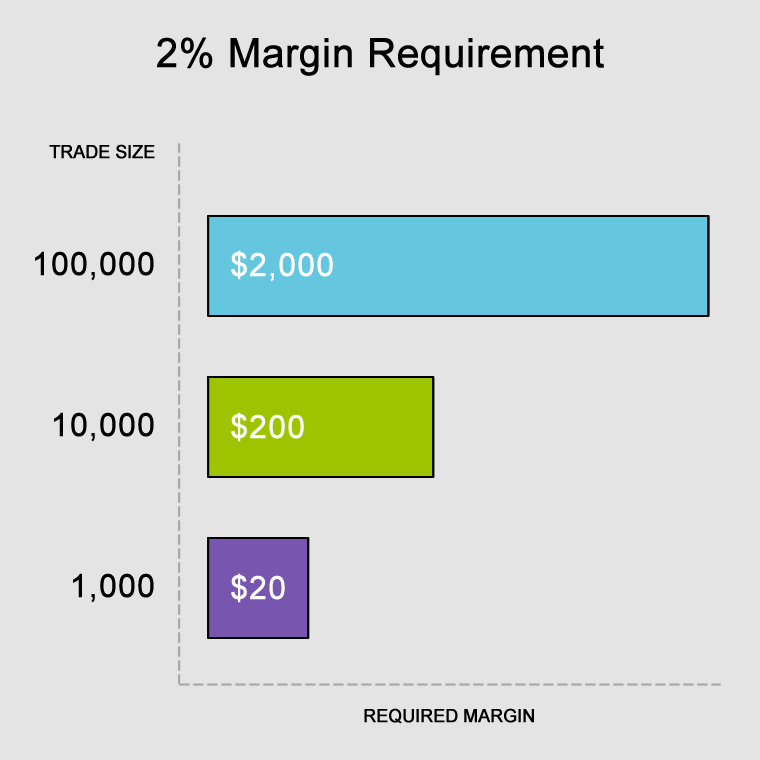
Let’s look at a typical EUR/USD (euro against U.S. dollar) trade. To buy or sell a 100,000 of EUR/USD without leverage would require the trader to put up $100,000 in account funds, the full value of the position.
But with a Margin Requirement of 2%, only $2,000 (the “Required Margin“) of the trader’s funds would be required to open and maintain that $100,000 EUR/USD position.
Example #1: Open a long USD/JPY position
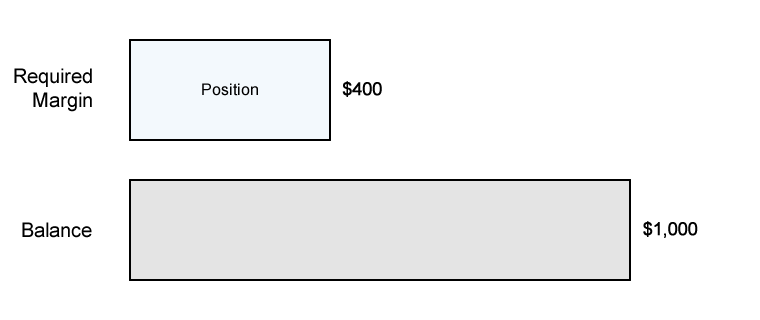
Let’s say you’ve deposited $1,000 in your account and want to go long USD/JPY and want to open 1 mini lot (10,000 units) position.
How much margin will you need to open this position?

Since USD is the base currency. this mini lot is 10,000 dollars, which means the position’s Notional Value is $10,000.
Assuming your trading account is denominated in USD, since the Margin Requirement is 4%, the Required Margin will be $400.
Example #2: Open a long GBP/USD position
Let’s say you’ve deposited $1,000 in your account and want to go long GBP/USD at 1.30000 and want to open 1 mini lot (10,000 units) position.
How much margin will you need to open this position?
Since GBP is the base currency, this mini lot is 10,000 pounds, which means the position’s Notional Value is $13,000.
Assuming your trading account is denominated in USD, since the Margin Requirement is 5%, the Required Margin will be $650.

Example #3: Open a long EUR/AUD position
Let’s say you want to go long EUR/AUD and want to open 1 mini lot (10,000 units) position.
How much margin will you need to open this position?

Assuming your trading account is denominated in USD, you need to first know what the EUR/USD price. Let’s say EUR/USD is trading at 1.15000.
Since EUR is the base currency, this mini lot is 10,000 euros, which means the position’s Notional Value is $11,500.
Since the Margin Requirement is 3%, the Required Margin will be $345.

How to Calculate Required Margin
When trading with margin, the amount of margin (“Required Margin”) needed to hold open a position is calculated as a percentage (“Margin Requirement”) of the position size (“Notional Value”).
The specific amount of Required Margin is calculated according to the base currency of the currency pair traded.
If the base currency is DIFFERENT from your trading account’s currency, the Required Margin is then converted to your account denomination.
Here is the formula to calculate the Required Margin:
If the base currency is the SAME as your account’s currency:
Required Margin = Notional Value x Margin Requirement
If the base currency is DIFFERENT from your account’s currency:
Required Margin = Notional Value x Margin Requirement
x Exchange Rate Between Base Currency and Account Currency
The only reason for having funds in your account is to make sure you have enough margin to use for trading.
When it comes to trading forex, your ability to open trades is not necessarily based on the funds in your account balance. More accurately, it’s based on the amount of margin you have.
This means that your broker is always looking to see if you have enough margin in your account, which can actually differ from your account balance.
If this sounds confusing, don’t you worry. It’ll start to make more sense as we proceed.
Recap
In this lesson, we learned about the following:
- Margin Requirement is the amount of margin required to open a position. It is expressed as a percentage (%) of the “full position” size or “Notional Value” of the position you wish to open.
- Required Margin is the amount of money that is set aside and “locked up” when you open a position.
In previous lessons, we learned:
- What is Margin Trading? Learn why it’s important to understand how your margin account works.
- What is Balance? Your account balance is the cash you have available in your trading account.
- What is Unrealized and Realized P/L? Know how profit or losses affect your account balance.
Let’s move on and learn about the concept of Used Margin.